



Suporta ng pamahalaan para sa renewable energy
Sa ilalim ng National Renewable Energy Program (NREP), nagbibigay na ang pamahalaan ng Pilipinas ng iba’t ibang anyo ng suporta para sa pagpapaunlad ng renewable energy. Kabilang dito ang mga tax incentive, duty-free importation ng mga kagamitan, income tax holiday, green energy auction, feed-in tariff, net metering, at mga programa sa pagpopondo para hikayatin ang pamumuhunan sa renewable energy. Nagbigay-daan ang mga patakarang ito sa mabilis na pagdami ng mga proyekto sa renewable energy sa iba’t ibang sulok ng bansa.
Gayunman, pangunahing nakatuon ang mga insentibong ito sa malalaking kumpanya na may sapat na puhunan para magtayo ng malalaking planta ng kuryente. Mayroon ding mga programa para sa mga kabahayan, maliliit na negosyo, at mga komunidad—tulad ng rooftop solar at net metering—pero kadalasan na nangangailangan ang mga ito ng malaking paunang gastos, teknikal na kaalaman, at access sa pautang o iba pang pondo na hindi abot-kaya ng maraming Pilipino.
Dagdag pa rito, mas pinapabilis ng mga patakaran tulad ng pagpapahaba ng lease sa lupa hanggang 99 taon, Green Lanes para sa renewable energy (mas mabilis na pagproseso ng permit at insentibo), Strategic Investment Priority Plan (mga prayoridad na insentibong buwis at hindi buwis), CREATE MORE, at pagbubukas ng renewable energy sa 100% dayuhang pagmamay-ari ang pagpasok ng malalaking pamumuhunan sa renewable energy. Dahil dito, nababawasan ang mga regulasyong dapat sundin, bumababa ang gastos ng mga mamumuhunan, at mas nagiging paborable ang kalagayan para sa malalaking proyekto sa renewable energy.
May malalaking hakbang ang pamahalaan sa pagpapabilis ng pamumuhunan sa renewable energy. Pero nananatiling lubhang hindi pantay ang akses ng mga mamamayan sa mga oportunidad na dulot nito.
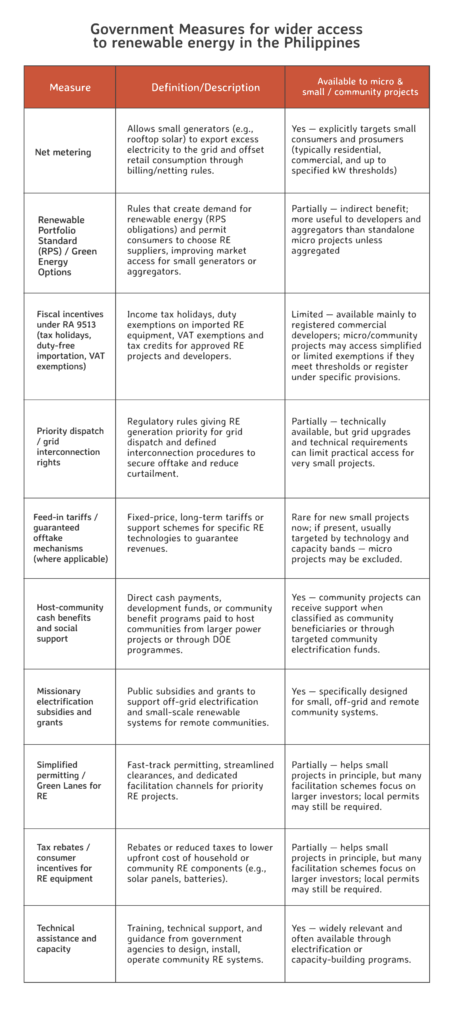
The table above shows that government measures for wider access to renewable energy in the Philippines are not designed to support small and community projects in a systematic way. Instead, they provide only fragmented, unevenly implemented opportunities that are often more suitable for larger, commercial developers. Six interrelated reasons explain why this is the case.
First, most of the core incentives—especially fiscal incentives under RA 9513 such as income tax holidays, duty-free importation of equipment, VAT exemptions, and tax credits—are explicitly targeted to registered commercial RE developers. Micro and community projects may only access simplified or limited exemptions if they meet certain capacity thresholds or undergo special registration, a process that is often administratively complex and costly. As a result, the biggest financial benefits remain concentrated in large-scale projects, leaving small generators without comparable support.
Second, the market access tools that could enable broader participation, such as the Renewable Portfolio Standard (RPS) and Green Energy Options, are primarily useful to developers and aggregators. These mechanisms create demand for renewable energy and allow consumers to choose RE suppliers, but stand-alone micro or community projects typically cannot benefit directly unless they are aggregated into larger portfolios. This aggregation requirement imposes technical, legal, and financial burdens that many small groups cannot meet.
Third, interconnection and dispatch rules that are technically open to all RE generators are often harder for very small projects to use in practice. While priority dispatch and defined interconnection procedures exist on paper, grid upgrades, technical standards, and capacity limits in host areas can delay or block micro projects. The interconnection studies and compliance requirements are frequently designed around larger capacities, making them proportionally more burdensome—and sometimes effectively inaccessible—for small-scale generators.
Fourth, consumer-focused schemes such as net metering, while explicitly targeting small consumers and prosumers, are limited in scope and consistency. Capacity caps, eligible technology restrictions, and billing rules can restrict how much small projects can export or how credits are valued. In practice, implementation varies across distribution utilities, and the application processes and technical requirements can be disproportionate for very small installations, dampening their real impact on community-level deployment.
Fifth, streamlined permitting and “green lanes” for RE are beneficial in principle but not uniformly accessible to small projects. Many facilitation schemes are calibrated for larger investors, with streamlined processes focused on big projects, while local-level permits for environmental clearance, land use, building, and local business requirements still apply to small projects and can be fragmented, slow, or inconsistent across LGUs. Similarly, tax rebates or consumer incentives for RE equipment are directly relevant but often underfunded, limited in scope, or not widely advertised, which reduces their practical reach.
Finally, community-focused benefits such as host-community cash payments, social support programs, and missionary electrification subsidies are important but narrow and project-specific. They are often tied to specific programs or large concession areas rather than to a general, scalable framework for community RE developers. While community projects may qualify as beneficiaries, they rarely have direct access to launch-level funding or long-term support comparable to large developers. Technical assistance and capacity-building programs are also widely relevant but typically delivered through electrification programs or donor-funded projects rather than as a continuous, national service that small developers can reliably tap into over time.
Taken together, these six factors mean that small and community RE projects face higher transaction costs, uncertain revenue streams, and weaker financial incentives than large developers. The regulatory framework is not systematically designed to level the playing field for micro and community-scale renewable energy, even where some tools such as net metering, missionary subsidies, and capacity building are theoretically available.